
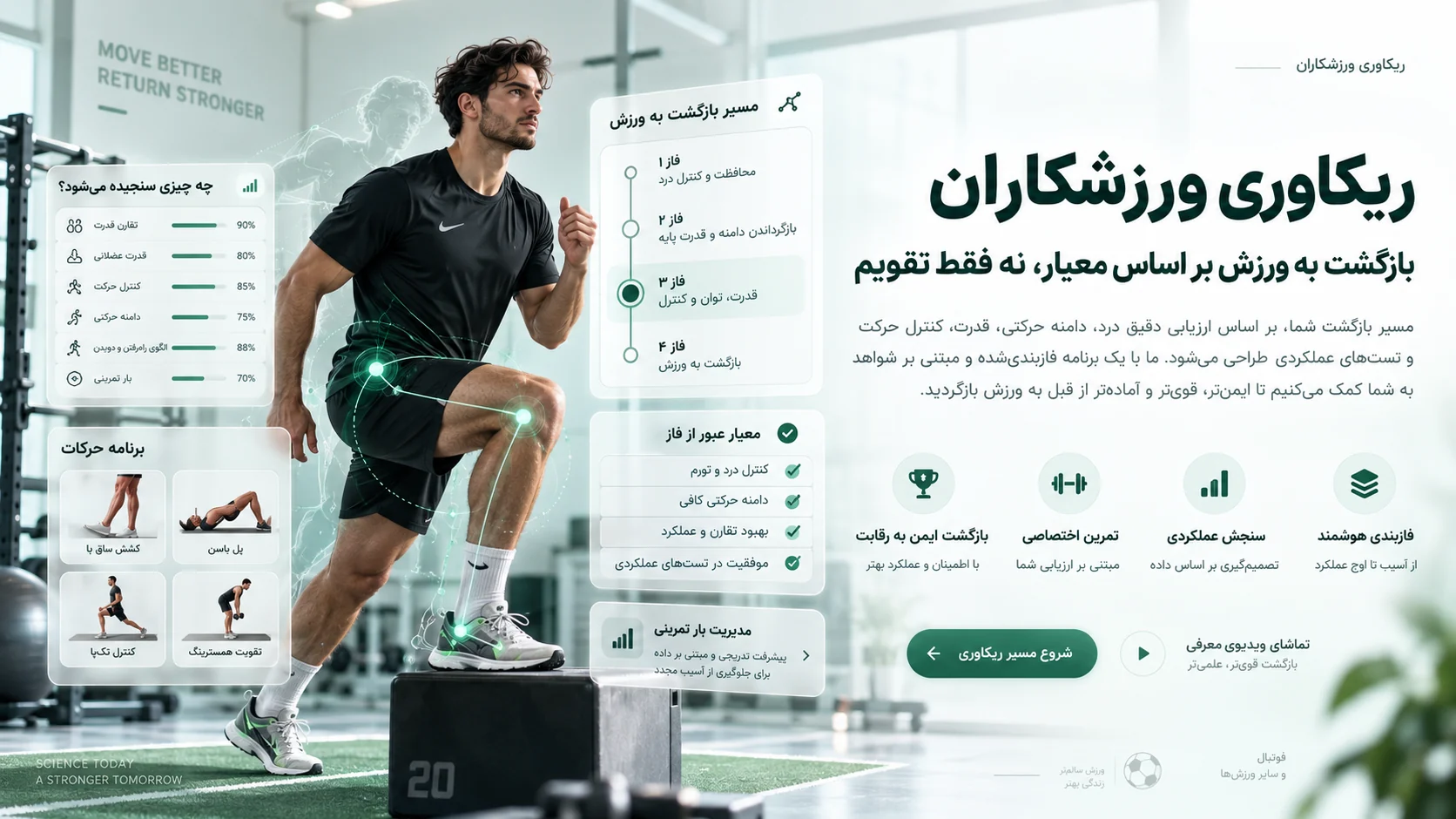
Why time alone is not a criterion
Injured tissue heals over a defined period, but functional capacity — strength, neuromuscular control, explosive power, and confidence in that limb — returns at its own pace and differs between people. An athlete who returns on the calendar alone may have healed tissue but not recovered control.
Functional criteria measure that gap. The best known is the limb symmetry index: the performance of the injured limb relative to the uninjured one. In the return-to-sport literature, reaching above ninety percent across a set of tests is recognised as one of the necessary conditions — necessary, not sufficient.
What is measured
| Domain | Example measure | Why it matters |
|---|---|---|
| Strength symmetry | LSI > 90% | The weaker limb passes load on to the rest of the chain |
| Power symmetry | Single-leg hop tests | Static strength may have returned while explosive power has not |
| Movement control | Knee alignment on landing | Dynamic valgus on landing is a recognised risk factor for re-injury |
| Range of motion | Compared with the other side | Residual restriction builds a compensation pattern |
| Walking and running pattern | Step symmetry | A residual limp is often invisible to the athlete |
| Training load | Acute to chronic load ratio | A sudden jump in load is itself an injury mechanism |
Managing training load
One of the most common mistakes in returning is the load jump: after weeks of reduced activity, the athlete goes straight back to their pre-injury training volume. The body adapts to relative load, not absolute load — what matters is how much this week's load exceeds the average of the preceding weeks.
The programme built here defines load progression in explicit phases and, for each phase, writes down the condition for moving to the next. That condition is always a functional criterion, never the passage of time.
Two paths: planning online and testing in person
What genuinely happens online. You choose your sport, your goal, the injured region and the phase you are currently in, and the programme for that phase is built — the exercises, the volume and repeats, and the condition for moving on — ready to print, with no account and from anywhere.
What genuinely needs hands on. The numbers themselves. Limb symmetry index, single-leg hop tests, side-to-side strength measurement and assessing knee alignment on landing all require measurement with an assessor present; a web page cannot measure your quadriceps strength. The decision to return to competition rests on those measurements and is taken together with your medical team.
That part happens at the clinic in Quchan, and athletes come in from Quchan, Faruj, Dargaz, Chenaran and Mashhad. Neither path replaces the judgement of your surgeon or team physician.
Phases of return
- Symptom controlReducing pain and swelling, restoring baseline range of motion, reactivating inhibited muscles.
- Rebuilding strengthTargeted resistance training for the injured limb, with the difference between sides tracked numerically.
- Power and controlPlyometric and landing-control work, with knee and pelvis alignment assessed during movement.
- Sport-specific skillGradual return of sport-specific movements, at first without an opponent and without sudden changes of direction.
- Return to competitionOnly after passing the functional criteria and with the medical team's approval.
Who this suits
- Athletes after cruciate ligament, meniscal or ankle injury who want to know whether they are genuinely ready.
- Anyone with an injury that keeps recurring — repeat injury usually means the underlying issue was never resolved.
- Uninjured athletes who want to find hidden asymmetries before they become injuries.
- Coaches who want the return decision grounded in data rather than in how the athlete feels.
Notes on common injuries
Anterior cruciate ligament
The longest return path and the highest re-injury rate. Two things decide it: full recovery of quadriceps strength — which is often still deficient months after surgery — and control of knee valgus on landing and cutting. Returning early is the best documented risk factor for a second injury.
Ankle sprain
Becomes chronic more often than people expect. The problem is usually not residual pain but lost proprioception, which leaves the ankle unstable on uneven ground. Targeted balance work is the core of the programme.
Hamstring strain
Has a high recurrence rate, especially when return is based only on pain resolving. Strength at long muscle lengths and speed control are more important criteria than range of motion.
Patellofemoral pain and shin splints
These are usually not acute injuries but the result of cumulative load. Resolving them without examining the walking and running pattern and foot mechanics is usually temporary.
Pre-season screening
The most effective time for this assessment is before an injury, not after one. Pre-season screening finds asymmetries and range restrictions while they are still symptom-free and correcting them takes weeks rather than months. For teams, the assessment can be run as a group and used as the season's baseline.
Working with the medical team
This assessment does not replace the opinion of your surgeon or team physician; it works alongside it. If you have had surgery, your surgeon's protocol takes precedence and the exercise programme is built to fit it. The functional report is written so that you can hand it to your medical team.
Frequently asked questions
How soon after ACL surgery can I be assessed?
Your surgeon sets the timing. Functional assessment generally becomes meaningful from the stage where full weight bearing and resistance training are permitted.
Does a symmetry index above 90% mean I can return?
It means you meet one of the necessary conditions. A safe return needs a set of criteria: strength, power, movement control, range of motion, and clearance from your medical team.
I am not a professional athlete — is this still useful?
Yes. Recreational athletes are more exposed to sudden jumps in training load than professionals, because they rarely follow a controlled programme.
How long does the programme take?
It depends on the injury, the stage you are at and your sport. Phases are defined by pass criteria, so their duration is not fixed in advance.
Do I have to travel to Quchan for this?
Not to build the phased programme — you do that from anywhere in your own browser and print it. But measuring the symmetry index, the hop tests and landing control needs measurement with an assessor present, and that happens at the clinic in Quchan, Razavi Khorasan.
Can I give the programme to my coach or physiotherapist?
Yes — the programme and the pass criteria for each phase are printable and written for exactly that. If you have had surgery, your surgeon's protocol takes precedence and the programme is built to fit it.