
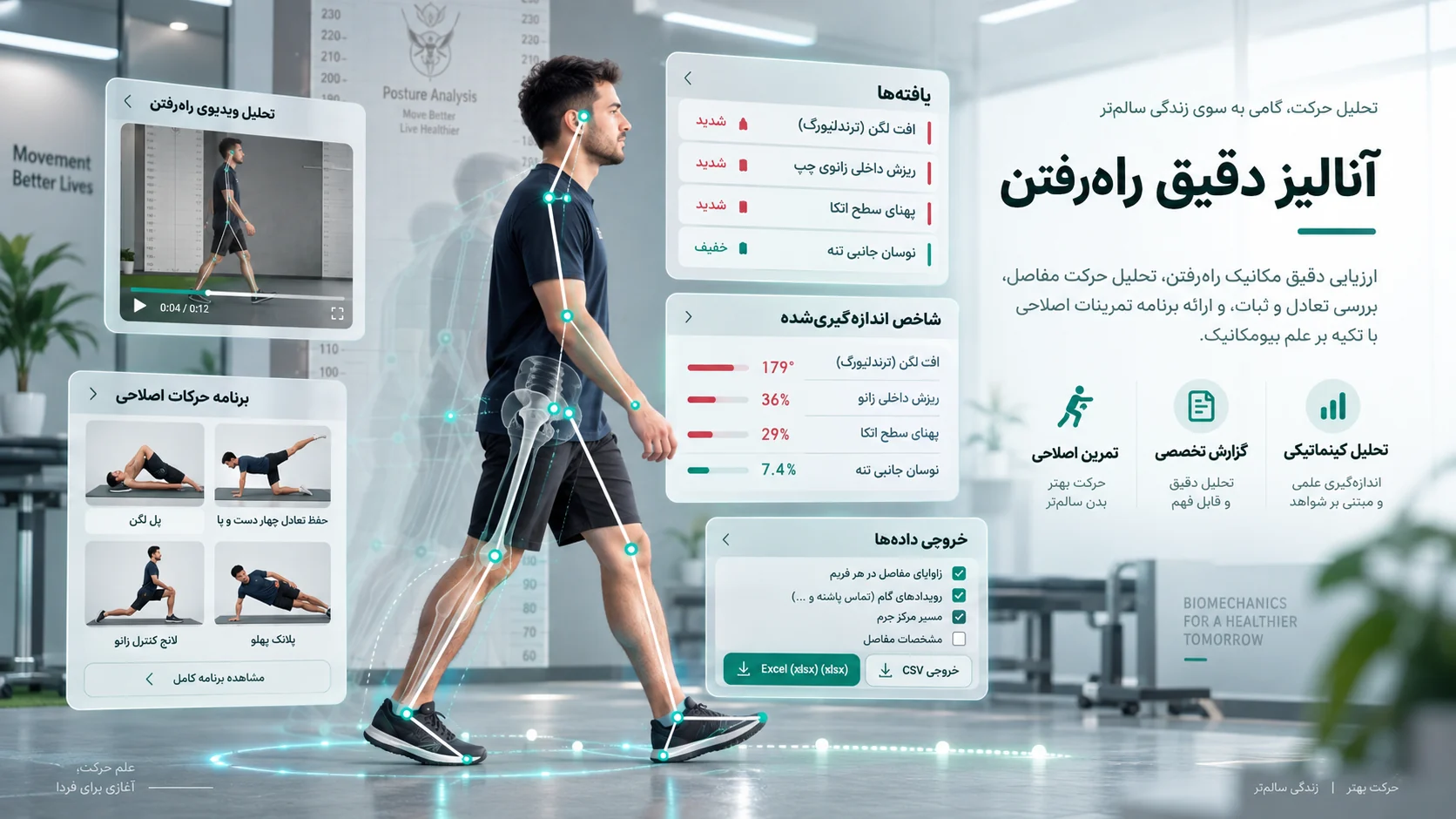
The gait cycle, and where problems show up
A full gait cycle runs from one heel contact to the next heel contact of the same foot, and divides into two phases: stance, when the foot is on the ground, taking roughly sixty percent of the cycle, and swing, when the foot is in the air, taking the remaining forty percent.
Most problems reveal themselves in the transitions between those phases: the moment of heel contact, the moment weight transfers onto one leg, and the moment the toes leave the ground. At normal walking speed these moments are far too brief to examine by eye — which is why frame-by-frame analysis is needed.
Two paths: home video and the in-person session
What genuinely happens online. You film yourself with your own phone and the video is analysed right there, in the browser on that device — cadence, stance share, symmetry index, pelvic drop and joint range come out as numbers, and no account is needed. All it takes is five to seven metres of straight path, even light and somewhere steady to rest the phone; which city you live in makes no difference.
What genuinely needs hands on. The numbers say what the walking pattern looks like, not why it came to look that way. Answering the "why" takes manual work: measuring ankle and hip range, checking hip abductor strength, looking at the wear pattern on your own shoes, and watching you walk at different speeds. The corrective exercise programme is written from that. This part happens at the clinic in Quchan, and people come in from Quchan, Faruj, Dargaz, Chenaran and Mashhad.
If there is nowhere suitable to film at home, the video can be recorded during the in-person session instead. Neither path replaces a physician's examination or medical imaging.
What gets extracted
| Measure | Common reference range | What a deviation suggests |
|---|---|---|
| Cadence (steps per minute) | 100–120 | Low cadence often accompanies fear of falling or pain |
| Stance phase share | ~60% | Shortened on one side means avoiding load on that leg |
| Step symmetry index | < 10% | A persistent asymmetry concentrates load on one side |
| Pelvic drop in stance | < 5° | Weak hip abductors (Trendelenburg sign) |
| Foot progression angle | 5–10° external | Excessive rotation shifts load to the inner border of the foot |
| Knee range through the cycle | ~60° | Restriction usually indicates pain or joint stiffness |
The symmetry index is the single most important number in this report. In normal walking the body works almost symmetrically; when one side is consistently different, something on that side — or on the opposite side, which is compensating — usually needs looking at.
How to record the video
- Three views are neededFront, back and side. Each gives different information: the lateral view for joint range, the front and back views for symmetry and pelvic drop.
- Keep the camera stillRest the phone on a stable surface or use a tripod. A moving camera invalidates angle measurement.
- Enough straight pathAt least five to seven metres of level ground, so several full cycles are captured. Walk at your own normal speed, neither slower nor faster.
- Clothing and lightingClothing that hides the joint lines makes landmark detection harder. Even light and a plain background give the best result.
- Analysed in the browserThe video is analysed right there in your browser.
Who needs gait analysis
- People with a limp left over after surgery or injury — including a mild one they have not noticed themselves.
- Runners with recurring injuries in the shin, knee or ankle.
- Older adults whose balance has changed or who are afraid of falling; reduced cadence and shortened steps are early signs.
- Children whose parents are unsure about their walking pattern — toe walking, in-toeing.
- Anyone fitted with orthotic insoles who wants to know whether their gait pattern has changed.
What the report shows
- A timeline of the gait cycle for both legs, side by side, so differences are visible
- A numeric table of every measure beside its reference range
- Key frames — heel contact, mid-stance, toe-off — with angles drawn on the image
- Percentage asymmetry between sides for each measure
- Out-of-range findings, ordered by mechanical importance
Walking and running are not the same
In walking at least one foot is always on the ground; in running there is a flight phase where neither is. Impact force in running is several times that of walking, and the mechanics differ too: initial contact point, shank angle at contact and loading rate are all measures that carry no equivalent meaning in walking.
For runners with recurring injuries, the analysis should be run on running video, not walking video. Running cadence, stride length and vertical displacement of the centre of mass are the three measures most closely related to the load on the shin and knee.
How gait relates to the rest of the body
A gait pattern is rarely an isolated problem. A flat foot changes the contact pattern, weak hip muscles produce pelvic drop, and restricted ankle range carries the chain all the way up to the lower back. For that reason gait analysis is usually read together with posture analysis and foot scanning — three measurements that together build a fuller picture than any one of them alone.
Where this assessment stops
Two-dimensional video analysis is not a substitute for a 3D motion capture laboratory and carries its own measurement error, particularly for angles rotated away from the camera plane. For tracking change over time — its main use — it is accurate enough, provided the recording conditions are the same each time.
Frequently asked questions
Can I record with an ordinary phone?
Yes. Any phone that records 30 frames per second is enough. Keeping the camera still and respecting distance and lighting matters more than camera quality.
How does this differ from a motion analysis laboratory?
Marker-based motion capture with several calibrated cameras gives three-dimensional measurement at higher accuracy. Two-dimensional video analysis is far more accessible and suits screening and tracking change, but does not match that accuracy.
How soon after knee surgery can I have gait analysis?
Your surgeon or physiotherapist decides that. Generally, once you are cleared for full weight bearing and unaided walking, the analysis becomes meaningful.
Do I have to travel to Quchan for gait analysis?
Not to get the numbers — you film yourself from anywhere with your own phone and the analysis runs in that browser. But interpreting why the pattern looks the way it does — measuring joint range, checking hip muscle strength, reading your shoe wear — and writing the exercise programme happen in the in-person session at the clinic in Quchan.
What if I have nowhere suitable to film?
A hallway at home or a quiet stretch of pavement with five to seven metres of straight path is usually enough, and the phone can rest on any steady surface. If nothing like that is available, the video is recorded during the in-person session in Quchan instead.