
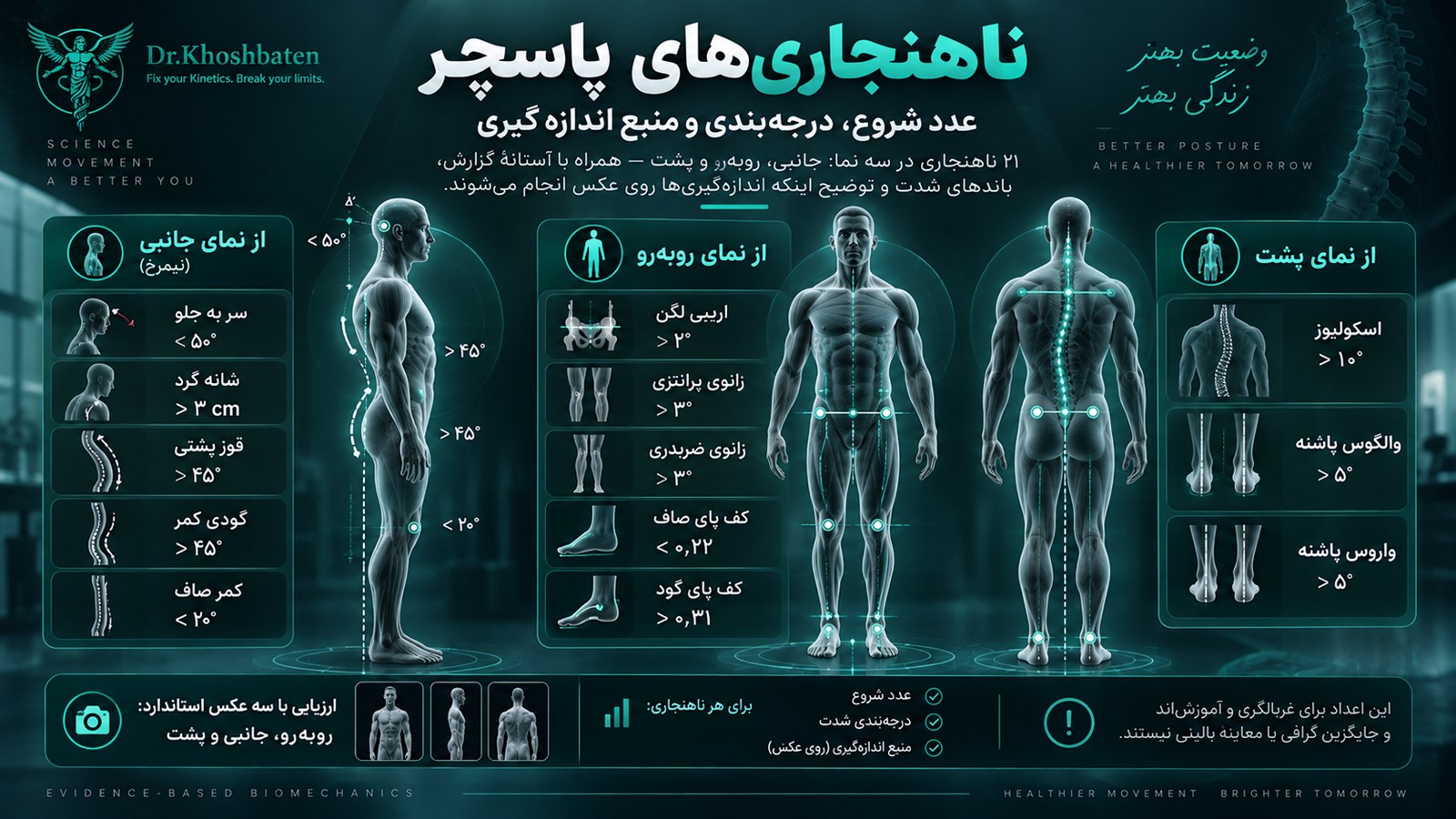
From the side view
- Thoracic hyperkyphosis — Excessive rounding of the upper back with forward shoulders and a forward head. reported from above 45°
- Lumbar hyperlordosis — A deep lumbar curve with the belly forward, worse on prolonged standing. reported from above 45°
- Flat back — A low back with no natural curve, tiring quickly on standing. reported from below 20°
- Sway back — The pelvis in front of the ribcage with a flat low back and a long thoracic hump. reported from above 3°
- Anterior pelvic tilt — The front of the pelvis lower than the back, with a deeper lumbar curve and the belly pushed forward. reported from above 15°
- Posterior pelvic tilt — The pelvis rotated back with a flattened low back and a tucked buttock. reported from above 0°
- Forward head posture — The head sitting in front of the shoulder line, with neck and shoulder pain by the end of the day. reported from below 50°
- Rounded and protracted shoulders — Shoulders sitting in front of the trunk line, pulling the scapula away from the chest wall. reported from above 3 cm
- Genu recurvatum — A knee that passes the straight line and locks backward on standing. reported from above 5°
From the front view
- Pelvic obliquity — One half of the pelvis higher than the other on standing, with uneven shoulders. reported from above 2°
- Leg length discrepancy — An uneven pelvis on standing with one-sided back pain and asymmetric shoe wear. reported from above 4°
- Lateral trunk shift — The trunk shifted to one side relative to the pelvis, usually with low back pain. reported from above 1 cm
- Acquired torticollis — A sudden or gradual neck tilt in an adult, with painful spasm. reported from above 2°
- Genu varum — A gap between the knees standing with the feet together, overloading the medial condyle. reported from above 3°
- Genu valgum — The knees touching with a gap between the ankles, loading the lateral condyle. reported from above 3°
- Pes planus (by arch height) — A medial arch lower than normal, measured as navicular height against foot length. Whether that arch is… reported from below 0.22
- Pes cavus (by arch height) — A medial arch higher than normal. Load shifts onto the heel and the metatarsal heads, and the foot absorbs… reported from above 0.31
From the back view
- Structural scoliosis — A sideways spinal curve with vertebral rotation, giving a rib hump on forward bending. reported from above 10°
- Functional scoliosis — A sideways curve that disappears on sitting or when the leg length is equalised. reported from above 10°
- Rearfoot valgus — A heel angled in or out when seen from behind, wearing the shoe on one side. reported from above 5°
- Rearfoot varus — A heel angled in or out when seen from behind, wearing the shoe on one side. reported from above 5°
Every number on these pages is measured on the skin surface in a photograph and does not replace imaging. The thresholds and their sources are the ones the clinic's own report is graded with.
Frequently asked questions
Where do these numbers come from?
From the same table the site's own tool grades with. Every band carries its source, and where the literature gave no second line the ladder stops rather than inventing one.
Do these pages replace an examination?
No. These are surface measurements taken from a photograph; they correlate with measurements on a radiograph and do not replace them. Wherever the decision depends on imaging, that finding's page says what would confirm it.
How do I find out which one I have?
From three standing photographs — front, side and back. The online assessment measures the same angles on your own photograph and prints the number and the grade for each.