
What it means
A sideways spinal curve with vertebral rotation, giving a rib hump on forward bending.
Where it comes from
A structural curve with rotation that does not correct with a change of position.
How it is measured
It is measured on the back view, in the coronal plane. The defining measurement is Sideways curve of the spine (Cobb angle), and it is reported as a finding from above 10°. The number is computed from landmarks on that photograph — not estimated by eye, and not compared against a stock example.
What the numbers mean
| Measurement | Grade |
|---|---|
| up to 10° | No scoliosis |
| 10–25° | Mild — monitoring and exercise |
| 25–40° | Moderate — bracing usually indicated |
| 40° and above | Severe — surgical assessment |
Source of the bands: Cobb JR, AAOS Instr Course Lect 1948;5:261-75 — SRS bands, applied here to a SURFACE trace, not a radiograph
What is usually seen alongside it
- One shoulder higher (Acromial tilt) — above 2°
- One shoulder blade higher (Inferior scapular angle level) — above 2°
- Upper body shifted to one side (Lateral trunk shift) — above 2°
None of these is a diagnosis on its own. Together they corroborate the finding; apart, they do not refute it — a measurement nobody took counts neither for nor against.
What confirms it
The Adams forward-bend test with a scoliometer: a trunk rotation of 5-7° or more is the referral threshold for a standing radiograph (Bunnell 1984). A true Cobb angle is read only on film.
Adolescent scoliosis — which number matters, and when
Scoliosis means a lateral curvature of the spine of 10° or more (Cobb angle, on a radiograph), usually with a rotational component. In adolescence its most common form is adolescent idiopathic scoliosis.
The numbers that decide the path
The evidence review for the U.S. Preventive Services Task Force [1] gathers three figures that decisions rest on:
- Curves progress in roughly two-thirds of cases before skeletal maturity is reached.
- Curves greater than 40° at the end of growth are likely to keep progressing after skeletal maturity.
- Curves under 30° at skeletal maturity are unlikely to progress significantly in adulthood.
Which means age and growth stage matter as much as the angle. The same curve means two different things in a growing adolescent and in an adult.
Conservative treatment has an international guideline
SOSORT [2] published its 2016 guidelines, and says the update was prompted by recently published high-quality clinical trials on bracing and exercise. Both sit inside a documented framework rather than in the realm of preference.
⚠️ But the choice between observation, scoliosis-specific exercise and bracing is made from the angle, the age, skeletal maturity and the pattern of progression — a clinical decision, not one that falls out of a photograph.
What a photographic measurement can and cannot do
What this centre measures is on the skin surface, and it is not a Cobb angle. The Cobb angle is measured on a radiograph, and it is what the thresholds above refer to. What a photographic screen does is find asymmetry and say whether it is worth investigating.
⚠️ If screening shows meaningful asymmetry — particularly during growth — the next step is a doctor and, where indicated, imaging. Not a self-started exercise programme.
References
- Dunn J, Henrikson NB, Morrison CC, Nguyen M, Blasi PR, Lin JS. Screening for adolescent idiopathic scoliosis: a systematic evidence review for the U.S. Preventive Services Task Force. Agency for Healthcare Research and Quality (US). 2018;Evidence Synthesis No. 156. PMID 29638297
- Negrini S, Donzelli S, Aulisa AG, Czaprowski D, Schreiber S, de Mauroy JC, et al.. 2016 SOSORT guidelines: orthopaedic and rehabilitation treatment of idiopathic scoliosis during growth. Scoliosis Spinal Disord. 2018;13:3. PMID 29435499 · DOI 10.1186/s13013-017-0145-8
The evidence on this
Study summaries that measured this finding — with their numbers and their limits.
- Scoliosis-specific exercise and the Cobb angle — Systematic review and meta-analysis, 18 randomised trials
The exercise programme
A lateral spinal curve is a three-dimensional problem and its exercise must be asymmetric and supervised. Symmetrical training does not help here.
⚠️ A curve beyond about 20° needs an in-person assessment and an X-ray. A scoliosis programme must be written specifically for the side of convexity and the level of the apex.
The stages advance on a standard, not on the calendar:
- Stage 1 — release and wake up — weeks 1–4: Quadratus lumborum stretch
Move on: When the movement is done without pain and without compensating, and the stretch is no longer what limits it. - Stage 2 — control — weeks 3–8: Side plank, Quadratus lumborum stretch
Move on: When the target muscle is felt through the whole range and the last set looks like the first. - Stage 3 — load and integration — weeks 6–16: Lateral elongation for scoliosis, Diaphragmatic breathing, Side plank
Move on: When the corrected pattern holds in everyday movement and under fatigue.
Each session 3–5 times a week, for at least 12 weeks. (from a study)
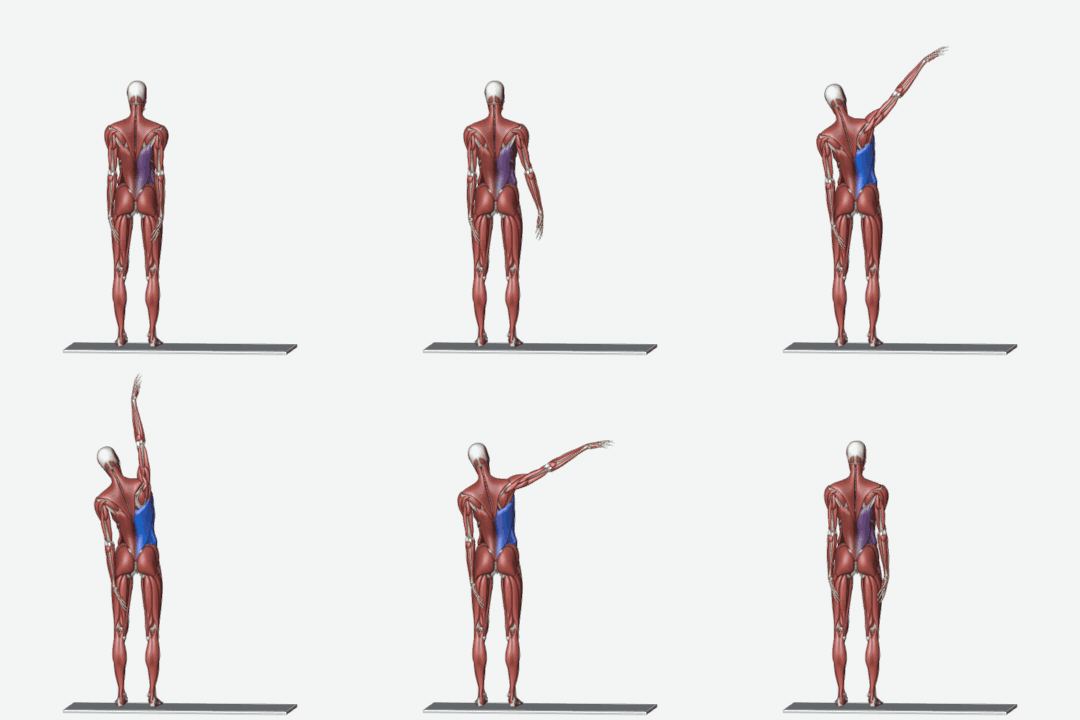
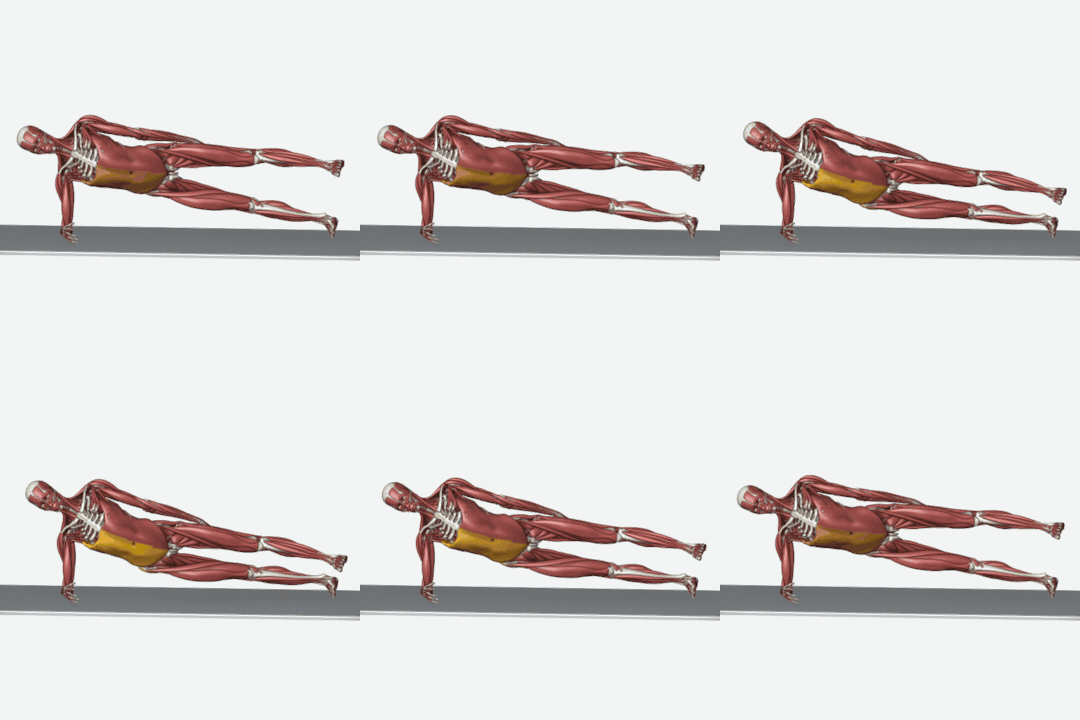
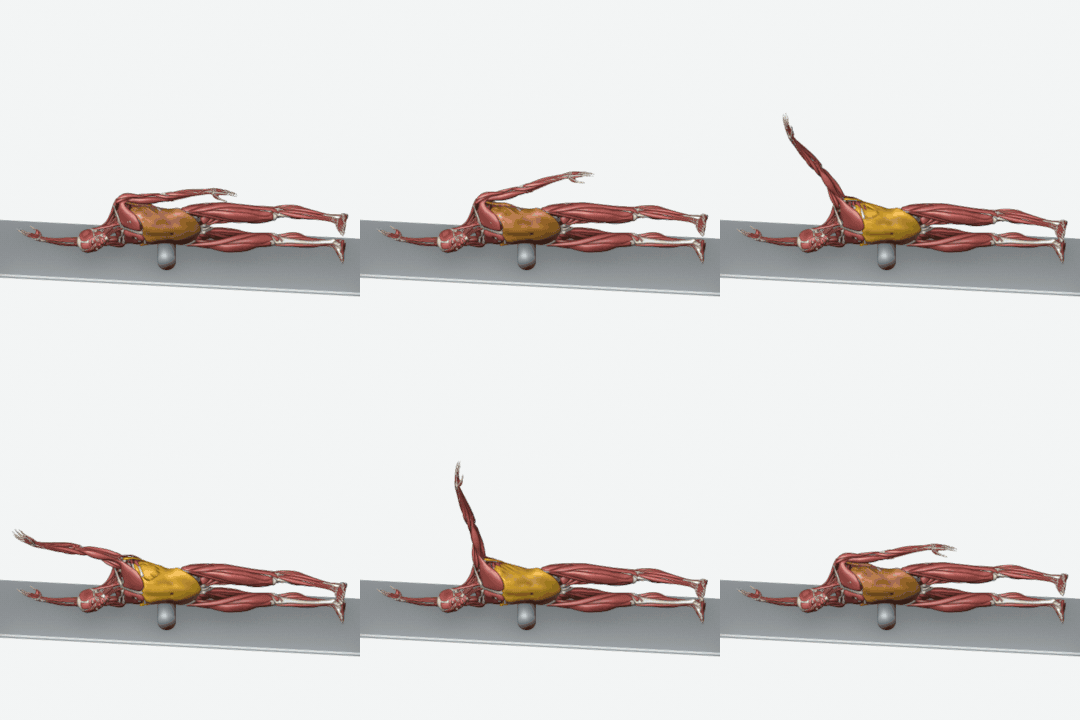
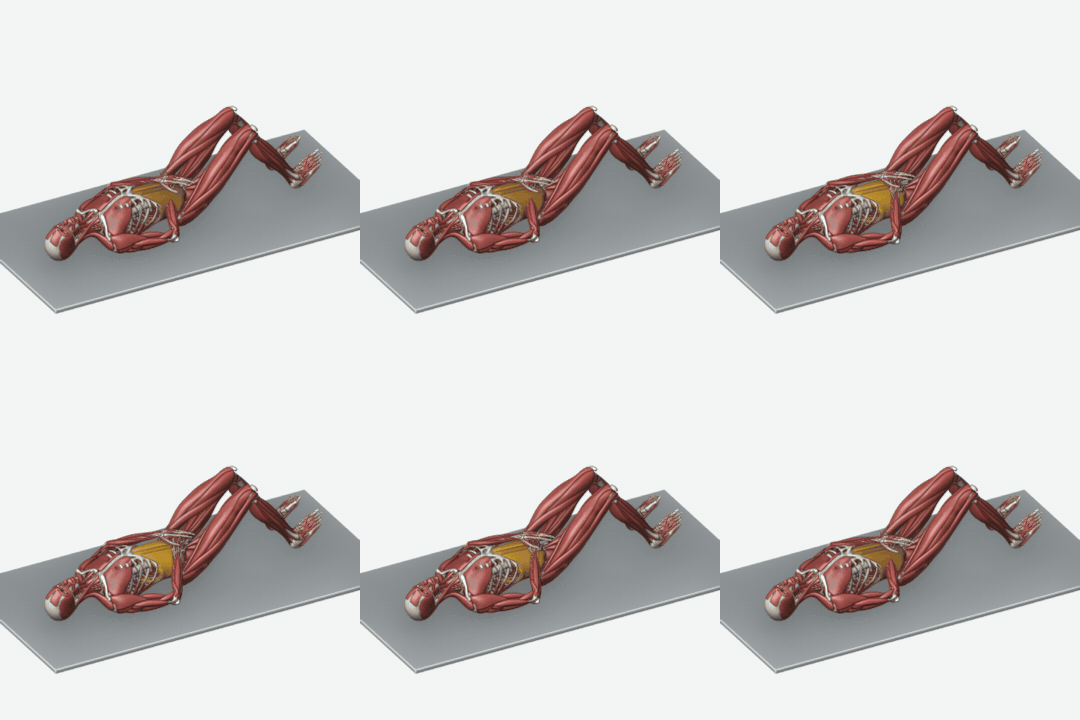
This example is for a moderate grade; each stage runs shorter or longer with the measured grade, and a person's own programme is written after assessment, around their other conditions and limits. If a movement causes pain, stop it and contact the clinic. Muscle colours in the animations: orange working, blue stretching, amber holding still.
Every number on this page is measured on the skin surface in a photograph. That is not the same as a measurement taken on a radiograph: it correlates with one and does not replace it. Wherever the decision depends on imaging, this page and the report itself say so.
What happens at the clinic
The assessment starts with three standing photographs — front, side and back. Every angle is measured on those photographs, the report prints the number and the grade for each, and the exercise programme is built from those numbers rather than from a template. Posture analysis explains the whole path, and the online assessment can be started from your own photograph now.
Frequently asked questions
At what point is structural scoliosis reported?
When sideways curve of the spine (cobb angle) is above 10°, it is reported as a finding. That is where the "Mild — monitoring and exercise" band begins. The bands come from: Cobb JR, AAOS Instr Course Lect 1948;5:261-75 — SRS bands, applied here to a SURFACE trace, not a radiograph
Can structural scoliosis be assessed from a photograph?
A photograph gives a number, which most assessments do not have. But it is a surface measurement and it does not replace imaging. The Adams forward-bend test with a scoliometer: a trunk rotation of 5-7° or more is the referral threshold for a standing radiograph (Bunnell 1984). A true Cobb angle is read only on film.
What is the most severe grade?
The worst band in this table is "Severe — surgical assessment". The grade is printed beside the measurement itself in the report, so it is always clear which number produced the word.