
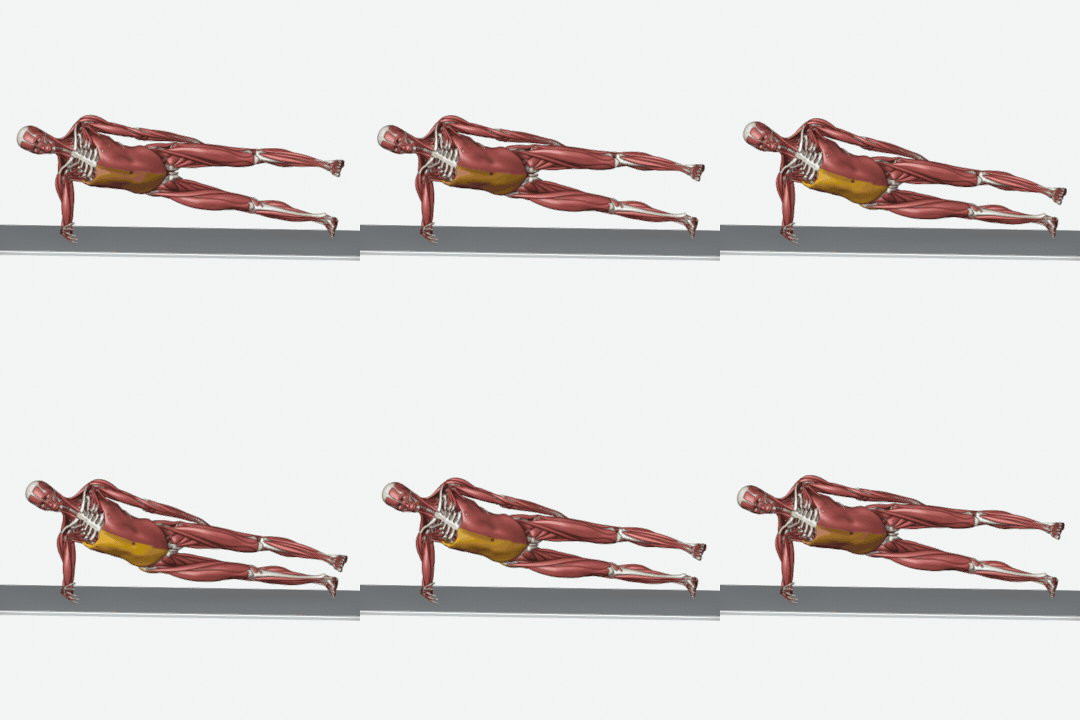
How to do it
One straight line from ear to ankle. The hip must not sag. Work the weaker side harder.
Default dose
3 × 30s · each side
This is the library's default dose. Each person's programme is set after assessment, around the grade of their finding and their own conditions and limits.
Muscles involved
- holding still Abdominal obliques, Quadratus lumborum, Gluteus medius
Muscle colours in the animation: orange working, blue stretching, amber holding still. These muscles were measured on the 3D model.
Where it sits in a programme: Activate the weak
The third phase is activation: strengthening a muscle that has become weak or underused, with controlled movement and light load, so it can carry its share of holding the body up.
Which postural findings it is prescribed for
It appears in the example programme on these pages:
- Sway back
- Structural scoliosis
- Functional scoliosis
- Pelvic obliquity
- Leg length discrepancy
- Lateral trunk shift
Take care
- Cardiovascular disease — Only under supervision: A long isometric hold pushes blood pressure up while it is held and invites breath-holding. Short holds and continuous breathing out, supervised.
- High blood pressure — Only under supervision: A long isometric hold raises blood pressure while it is held, especially if the breath is held with it. It needs a shorter hold and continuous breathing out.
- Pregnancy — Only under supervision: The ligament laxity of pregnancy allows more range than the joint can safely use. Stretch to tension, not to the end of range.
- If the movement causes pain or makes pain worse, stop and contact the clinic or your doctor.
Source
Textbook:
- McGill SM, Karpowicz A. Exercises for spine stabilization: motion/motor patterns, stability progressions, and clinical technique. Arch Phys Med Rehabil. 2009;90(1):118-26.
Technique and progression of the three foundational neutral-spine exercises: curl-up, side bridge and bird dog. - McGill S. Low Back Disorders: Evidence-Based Prevention and Rehabilitation. 3rd ed. Human Kinetics; 2016.
The foundational spine-stability exercises and the neutral-spine hip hinge.