
Why this group needs its own programme
Most corrective exercise programmes are written for a body with intact neuromuscular control. When that assumption does not hold — in neurological conditions, after a stroke, or in ageing with reduced proprioception — the same exercise can be ineffective or unsafe.
Three things differ: exercise selection based on actual rather than average capacity, safety conditions written for each exercise, and a measure of progress that here is often maintaining function rather than necessarily improving it.
Two paths — and why the order is reversed here
On the other five paths on this site, the online screening comes first. For this group the order is the other way round.
What genuinely happens online. Building and printing an exercise programme matched to the condition and level of function, with the safety conditions for each exercise and the list of signs that mean stopping; and working through the home safety checklist with the person's carer, with no account needed. A programme built that way is a proposal until the treating doctor approves it.
What genuinely needs hands on — and comes first here. Actually measuring balance and strength, seeing the walking pattern with the person's own walking aid, going through the history of falls and medications, and talking with the family about a goal that means something to them. A web page cannot tell you which exercise is safe for someone whose proprioception has declined.
The session takes place at the clinic in Quchan, and people come in from Quchan, Faruj, Dargaz, Chenaran and Mashhad. If travelling is difficult for the person themselves, call before arranging a time so their situation can be discussed.
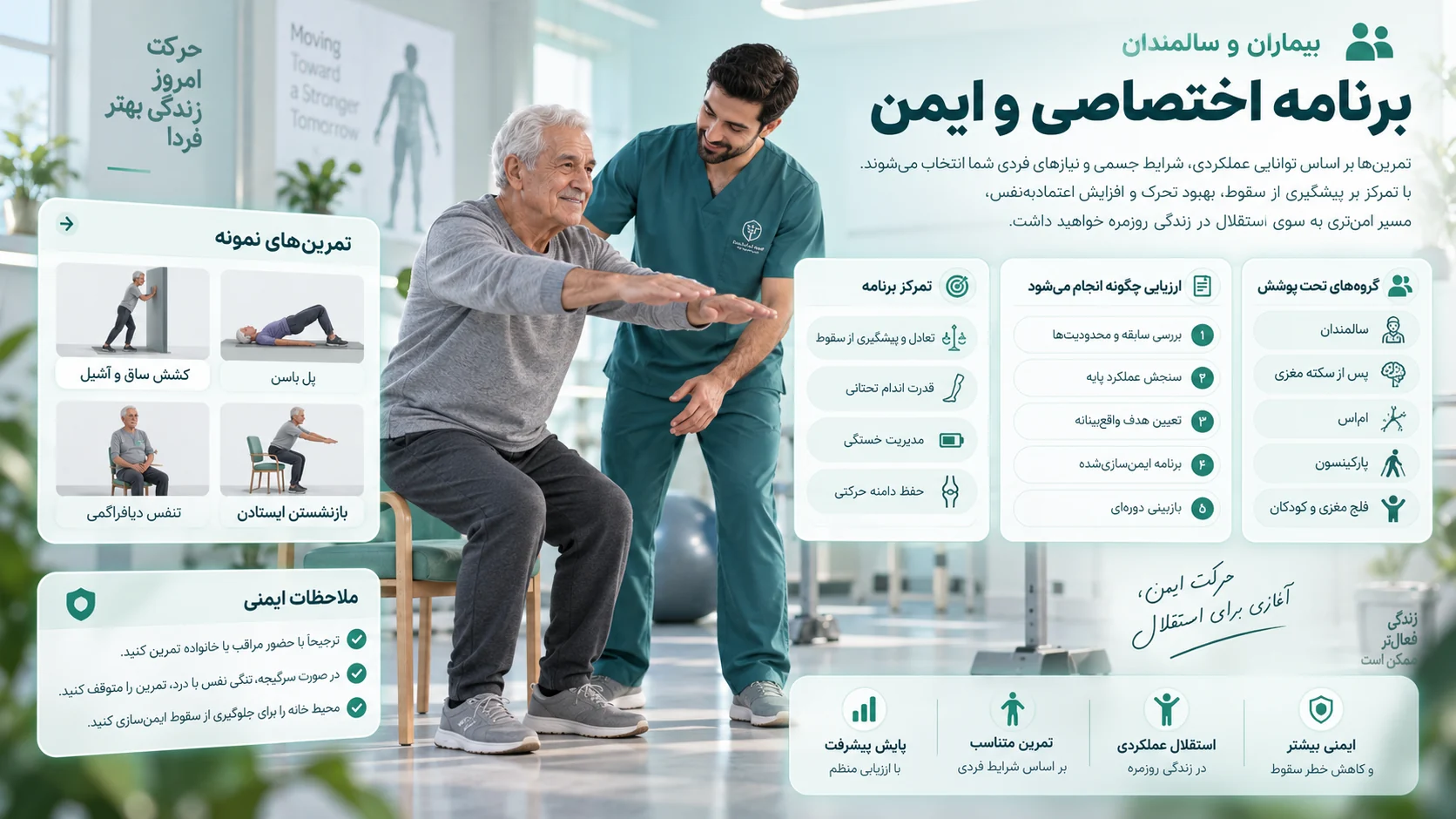
Groups covered
Older adults
The focus is static and dynamic balance, lower limb strength, and walking pattern. Reduced walking speed and shortened step length are early signs of increased fall risk, and both can be measured with gait analysis. Fear of falling is itself an independent factor: it reduces activity, and reduced activity raises the risk further.
After stroke
Work on the asymmetric walking pattern, trunk control, and active use of the affected side in daily activities. The programme is coordinated with physiotherapy, not a replacement for it.
Multiple sclerosis
Fatigue management is the central consideration: exercise must fit within the day's energy envelope, and heat sensitivity has to be accounted for. Exercise at an appropriate intensity, with adequate rest, is part of care.
Parkinson's disease
Focus on movement amplitude, posture, and strategies for dealing with freezing of gait. Large-amplitude exercises and external cues — rhythm, a line on the floor — have a recognised place in this group.
Cerebral palsy and children
The programme is set to the child's developmental age and level of motor function, and coordination with the child's care team is essential. With children, exercise has to take the form of play and meaningful activity or it will not be done.
How the assessment runs
- History and limitationsDiagnosis, medications, history of falls, and any limits set by the treating physician. This step is not optional.
- Baseline functionBalance, lower limb strength, walking pattern and the ability to carry out daily activities.
- A realistic goalThe goal is set with the person and their family: climbing stairs, walking to the end of the street, standing up from a chair unaided.
- A safety-adapted programmeEvery exercise is written with its own safety conditions: a point of support, whether someone should be present, and the signs that mean stop.
- Periodic reviewThe programme is not fixed and is revised as circumstances change.
Balance comes from three sources — and all three change with age
Standing without falling is the work of three systems whose outputs the brain combines:
- Vision — provides an external reference. Its contribution falls with reduced sight or in low light.
- The vestibular system of the inner ear — senses head acceleration and position.
- Proprioception — information from joints and muscles, particularly the ankle. This is usually the first to decline with age or neurological disease.
When proprioception weakens, a person unconsciously leans more on vision — which is why falls so often happen in the dark or when getting up at night. Effective balance training targets the system that has actually weakened, rather than being generic "balance work".
Making the home safer
A large part of reducing fall risk happens outside the exercise session. Go through this list with the person's family:
- Remove small rugs and curled edges, or fix them down
- Adequate lighting in the hallway and on the route from bedroom to bathroom, ideally with a motion sensor light
- Grab rails in the bathroom and beside the toilet, and a non-slip mat
- Keep busy routes clear of cables and objects
- Low-heeled shoes with non-slip soles, indoors as well — loose slippers or socks on tiles are a common cause of falls
- Keep everyday items within reach, so no step stool is needed
- Review medications with the physician; some cause dizziness or postural hypotension
Safety comes before everything else in this group
An exercise programme for this group starts only in coordination with the treating physician. No programme, including one you get from this site, should replace the instructions of your doctor or physiotherapist.
In these cases stop immediately and contact a physician:
- Chest pain, unusual breathlessness or palpitations
- Dizziness, blurred vision or feeling close to fainting
- Sudden weakness or worsening numbness
- A marked increase in spasticity or tremor
- Any fall, even without visible injury
The role of family and carers
In this group the carer is part of the programme, not a spectator. Teaching a carer how to assist safely during exercise, how to recognise the signs to stop, and how to make the home safer — good lighting, removing slippery rugs, fitting grab rails — often has more effect on reducing falls than the exercises themselves.
Frequently asked questions
My father has had one fall. Where do we start?
First a medical examination to rule out medication, cardiac or vision-related causes. After that, assessing balance and walking shows which component is weak, and the programme targets that.
Is exercise risky with multiple sclerosis?
Exercise at an appropriate intensity is recommended for most people with MS; the key points are managing fatigue and avoiding excessive heat. Intensity and type should be agreed with your treating physician.
Can the programme be done at home?
Most exercises are designed for home use with simple equipment. The conditions are a safe environment and someone present for exercises that challenge balance.
Is it suitable for my child?
A child's programme is set to developmental age and level of motor function and must be coordinated with the child's care team. For children under active treatment, the programme is complementary, not a replacement.
Can everything be done online for this group too?
No, and that is the important difference between this path and the other five. The programme can be built and printed from anywhere, but measuring balance and strength, going through the history of falls and medications, and talking with the family have to be done in person at the clinic in Quchan, Razavi Khorasan. The programme also needs the treating doctor's approval.