
How the arch is measured
A footprint carries a lot of information, provided numbers are extracted from it. Three indices are established in the biomechanics literature, and all three are computed from the ratio of the width or area of the midfoot to other parts of the foot:
| Index | Definition | High arch (cavus) | Normal | Flat (planus) |
|---|---|---|---|---|
| Chippaux–Smirak (CSI) | Minimum midfoot width ÷ maximum forefoot width | < 30% | 30–45% | > 45% |
| Cavanagh arch index | Midfoot area ÷ total footprint area | < 0.21 | 0.21–0.26 | > 0.26 |
| Staheli index | Minimum midfoot width ÷ maximum heel width | Low | Mid | High |
All three are computed and reported. If two indices disagree, the foot falls in a borderline band and the report says so explicitly — this is common and does not mean the measurement went wrong.
Flexible and rigid flat foot
This is the most important clinical distinction in any discussion of flat feet, and it cannot be made from a footprint alone:
- Flexible flat foot: the arch returns when sitting or standing on tiptoe. It is common, in many cases stays symptom-free, and is usually managed with exercise and, where needed, an insole.
- Rigid flat foot: the arch does not return in any position. This needs medical assessment, because it can have a structural cause.
For that reason, scanning a footprint is a starting point and not the end of the process: telling the two apart requires an in-person examination.
Two paths: online scanning and insole work in Quchan
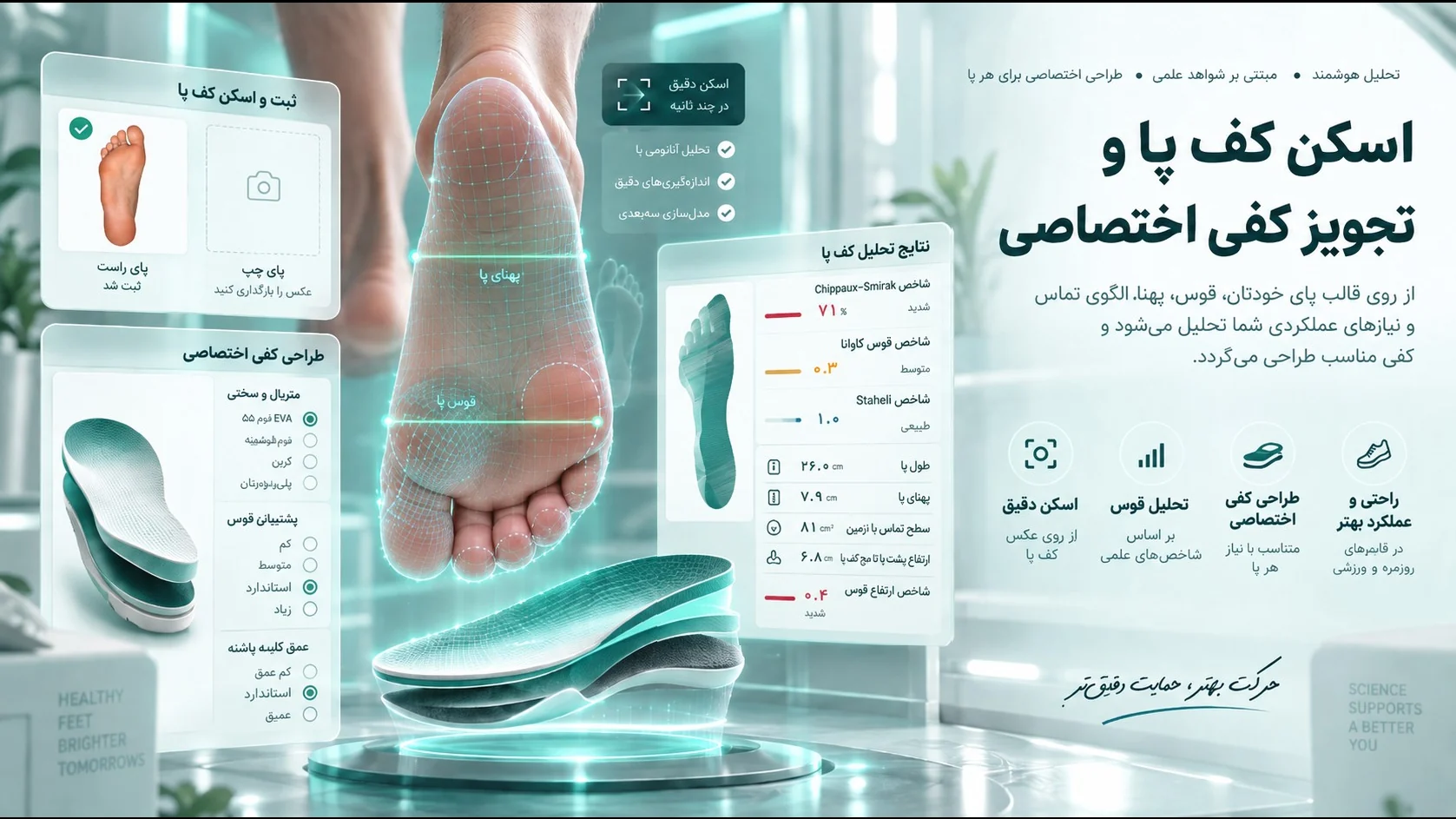
What genuinely happens online. Photographing both soles, separating the contact area, computing all three arch indices, determining foot type, arch peak position and hallux angle, viewing the 3D insole model, and producing a specification sheet with an order code. No account is needed, and this stage works from anywhere.
What genuinely needs hands on. A footprint shows the foot standing still, which is exactly why it cannot separate a flexible flat foot from a rigid one; that distinction is made with a tiptoe test and by checking hindfoot joint mobility by hand. Making the insole from a cast, trying it inside your own shoes, adjusting arch height and posting angle after a few days of wear, and the exercise programme that goes with the insole are all in-person work.
That part happens at the clinic in Quchan, and people come in from Quchan, Faruj, Dargaz, Chenaran and Mashhad. If you have diabetes or reduced sensation in your feet, the in-person path under medical supervision is required from the outset.
From scan to insole
- Photograph the solesBoth feet, following the on-page guide. Foot length is entered for scale so measurements convert to centimetres.
- Segmentation and measurementThe contact area is separated from the background and divided into heel, midfoot and forefoot; all three indices are then computed.
- Foot type and arch positionBesides foot type, the position of the arch peak along the foot and the hallux angle are extracted — both matter in insole design.
- 3D insole modelThe model is built from those numbers and you can rotate and inspect it.
- Choosing the specificationShell material and stiffness, arch height, heel cup depth, posting angle and, if needed, a metatarsal dome.
- Placing the orderA specification sheet with an order code is produced, readable by both you and the clinic.
The parts of an insole and what each one does
Shell
Shell stiffness determines how much the insole controls load and how much shock it absorbs. A stiffer shell suits motion control; a softer one suits pressure relief in sensitive or diabetic feet.
Arch support
Its height has to match the actual height of your arch. An over-high support under a flat foot creates a painful pressure point rather than helping.
Heel cup
Holds the fat pad under the heel together and stabilises the rearfoot. Its depth is set by the degree of pronation.
Posting
A controlled wedge under the rearfoot or forefoot, to correct the alignment of the foot's contact with the ground. Its angle comes from measurement, not from guesswork.
Metatarsal dome
A raised area just behind the metatarsal heads, to spread pressure in metatarsalgia. It is added only when the matching symptom is present.
Flat feet, high arches, and the chain above them
The foot is the first thing to meet the ground on every step, and any deviation in it is passed on to the joints above:
- Excessive pronation (more common with a flat foot) rotates the shank inward. That rotation reaches the knee and can play a part in patellofemoral pain and in load on the medial knee.
- A high, supinated foot absorbs less shock and has a smaller contact area. Pressure concentrates on the heel and the metatarsal heads, and lateral ankle instability increases.
Which means knee or back pain that no exercise has settled sometimes starts at the foot. That is why a foot scan is usually read alongside gait analysis: the footprint shows the static picture, and gait shows what the foot actually does in motion. The two do not always say the same thing.
What an insole does and does not do
An orthotic insole changes how pressure is distributed under the foot and alters the alignment of its contact with the ground. That can take load off a painful point. But an insole does not build an arch and does not change the shape of bones. Anyone promising that is promising something the mechanics of the foot do not allow.
For that reason an insole is almost always prescribed alongside an exercise programme, not instead of one. Strengthening the intrinsic foot muscles and the calf is part of that programme.
A warning about the diabetic foot
If you have diabetes — particularly with reduced sensation in your feet — insole design follows entirely different rules and must be done under medical supervision. An unsuitable insole on an insensate foot can create a wound you do not notice. An online assessment is not enough in this case.
Frequently asked questions
How long does it take to make an insole?
Production time depends on the specification and the material chosen. Once the specification sheet is finalised, the exact timing is given on the same call.
How long before I get used to wearing it?
An adaptation period of a few days up to two weeks is usual, and wearing time should be increased gradually. If new pain appears after that period, the insole needs reviewing — that is not something to put up with.
Is an over-the-counter insole any different?
An off-the-shelf insole has an average shape and can be sufficient for a foot without a particular problem. The difference with a custom insole is that arch height, cup depth and posting angle come from the measurements of your own foot.
Do flat feet always need treating?
No. Many people with a flexible flat foot have no symptoms at all and need no intervention. Intervention makes sense when there is pain, early fatigue or recurring injury.
Do children need insoles?
A child's arch is generally still developing until around school age, and flat feet at young ages are often normal. Deciding about insoles in children should follow an examination and take age into account, not rest on a footprint alone.
Do I have to travel to Quchan to be scanned and get insoles?
The scan and the specification sheet you produce from anywhere, in your own browser. But making the insole from a cast, trying it inside your own shoes and the adjustments that follow are in-person work, done at the clinic in Quchan, Razavi Khorasan.
Do I need a special scanner or pressure plate?
No. A photograph of each sole taken with your own phone, following the on-page guide, is enough; you enter your foot length so measurements convert to centimetres. Lighting and camera angle matter more than camera quality.