
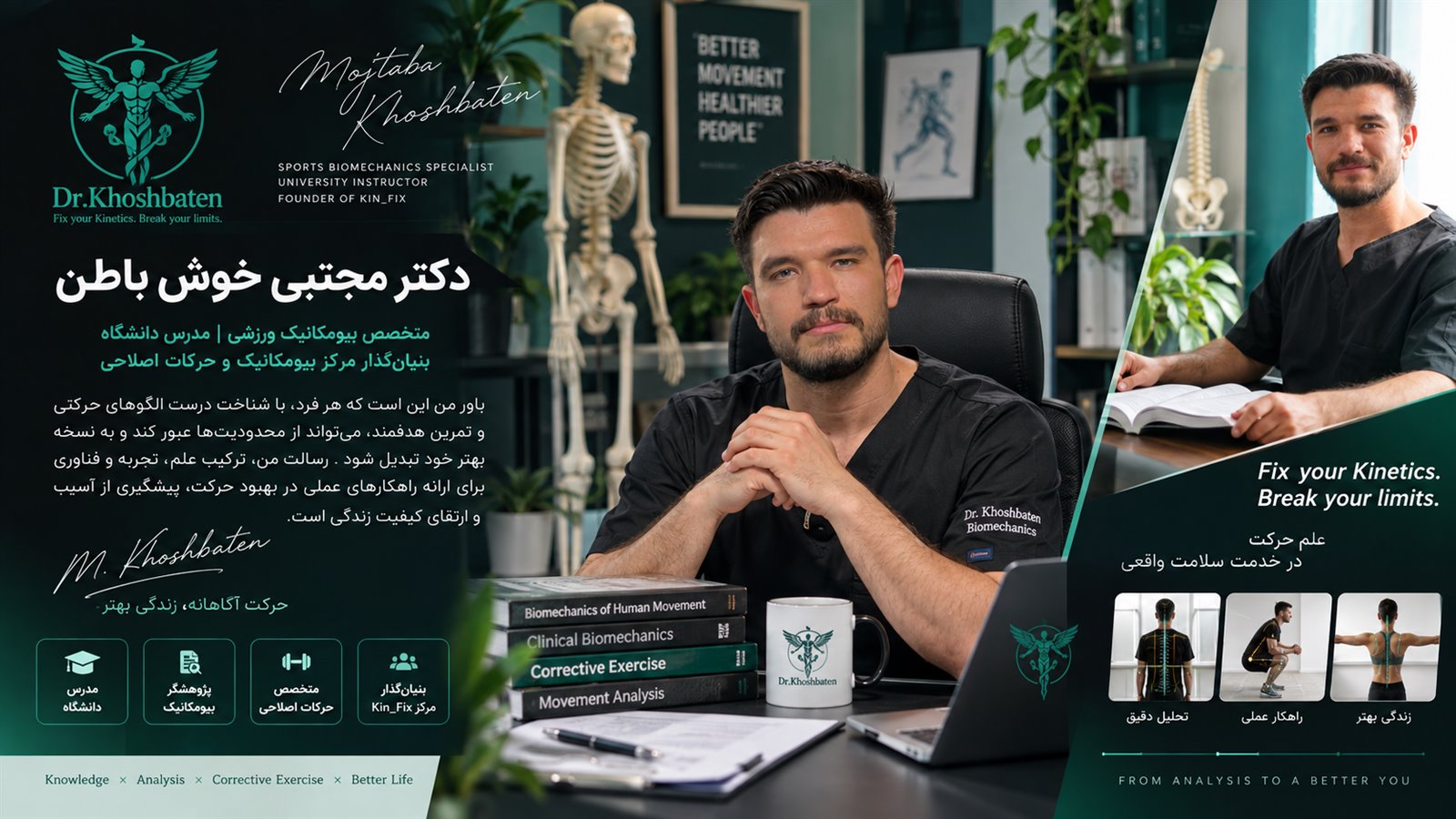
Dr. Mojtaba Khoshbaten holds a PhD in Biomechanics and Corrective Exercise from Kharazmi University and is a university faculty member, with ten years of clinical practice in Tehran.
His work sits where three fields meet: biomechanical modelling of human movement, ergonomic design of orthotics and prosthetics including insoles and braces, and instrumented assessment with electromyography and motion analysis systems. That combination is why assessment here rests on a measured number rather than on visual impression.
Background
- PhD in Biomechanics — Corrective exercise — Kharazmi University
- Faculty member — University teaching and research
- Orthotics and prosthetics designer — Insoles, braces and ergonomic devices
- EMG and motion analysis — Instrumented neuromuscular assessment
- Biomechanical modelling — Simulation and movement mechanics
- Ten years in clinic — Specialist practice in Tehran

What is done at this clinic
Seven assessments, each with a page of its own:
- Posture analysis — Alignment angles measured from three views, reported as numbers.
- 3D body scan — Height, girths, body composition, symmetry and centre of mass from one phone scan.
- Musculoskeletal screening — Screening from the pain point, using standard clinical tests.
- Gait analysis — Cadence, step symmetry and joint range extracted from video, frame by frame.
- Foot scan and orthotic insoles — Arch indices measured, and an insole designed from your own foot.
- Athlete recovery — Return-to-sport criteria and limb asymmetry control.
- Patients, older adults and children — A safety-adapted programme focused on balance and independence.
Where
Assessment in person takes place at the clinic in Quchan, Khorasan Razavi. People come from Quchan and the towns around it — Faruj, Dargaz, Chenaran — and from Mashhad. The initial online assessment can be done from any city.
What this clinic does not do
This clinic screens and assesses movement, and writes corrective exercise and orthotic programmes. Medical diagnosis, prescribing medication and reading imaging are a physician's work, not this clinic's. Wherever a finding needs a radiograph or a doctor's examination, the report says so and does not keep the path to itself.
Frequently asked questions
How is a PhD in biomechanics different from a physician?
A doctorate in biomechanics and corrective exercise is an academic degree in movement science, not a medical degree. The work here is measuring and assessing movement and writing a corrective programme. Medical diagnosis and the reading of imaging are a physician's work.
How is this different from a visual examination?
Instead of "your right shoulder sits a little lower", you get a number: how many degrees, on which view, at what grade and from which published source. The thresholds used to grade are published on this site.
Can this be done from another city?
The initial online assessment can be done from anywhere. The full assessment and any insole prescription are in person, at the clinic in Quchan.