
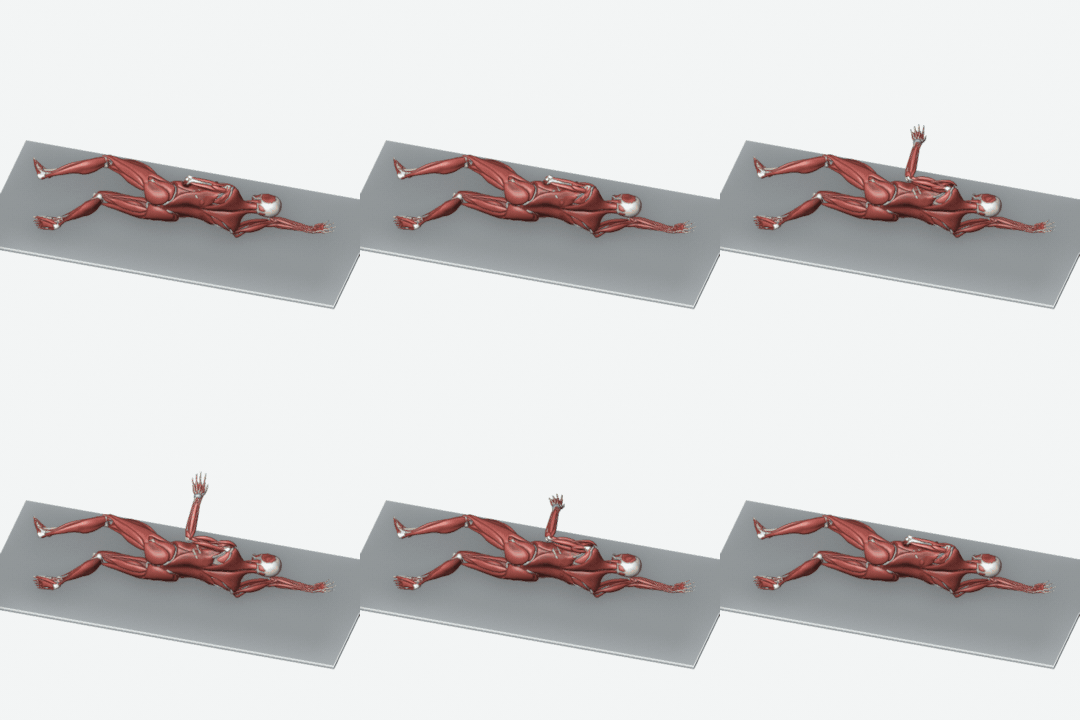
How to do it
Lie on your side with a rolled towel between elbow and waist, elbow at 90°. With a light weight, turn the forearm up toward the ceiling keeping the elbow on the towel; lower over three seconds.
Default dose
3 × 12 · each side
This is the library's default dose. Each person's programme is set after assessment, around the grade of their finding and their own conditions and limits.
Muscles involved
- working Shoulder external rotators
Muscle colours in the animation: orange working, blue stretching, amber holding still. These muscles were measured on the 3D model.
Where it sits in a programme: Activate the weak
The third phase is activation: strengthening a muscle that has become weak or underused, with controlled movement and light load, so it can carry its share of holding the body up.
Which postural findings it is prescribed for
It appears in programmes the tool prescribes after a musculoskeletal assessment.
Take care
- If the movement causes pain or makes pain worse, stop and contact the clinic or your doctor.
Source
Trial or systematic review:
- Reinold MM, Wilk KE, Fleisig GS, et al. Electromyographic analysis of the rotator cuff and deltoid musculature during common shoulder external rotation exercises. J Orthop Sports Phys Ther. 2004;34(7):385-94.
EMG: side-lying external rotation produced the most infraspinatus and teres minor activity. - Cools AM, Dewitte V, Lanszweert F, et al. Rehabilitation of scapular muscle balance: which exercises to prescribe? Am J Sports Med. 2007;35(10):1744-51.
EMG: the exercises that work middle and lower trapezius with the least upper trapezius, side-lying external rotation among them. - Holmgren T, Björnsson Hallgren H, Öberg B, Adolfsson L, Johansson K. Effect of specific exercise strategy on need for surgery in patients with subacromial impingement syndrome: randomised controlled study. BMJ. 2012;344:e787.
Trial: specific rotator cuff and scapular exercise reduced the need for surgery in subacromial impingement.