
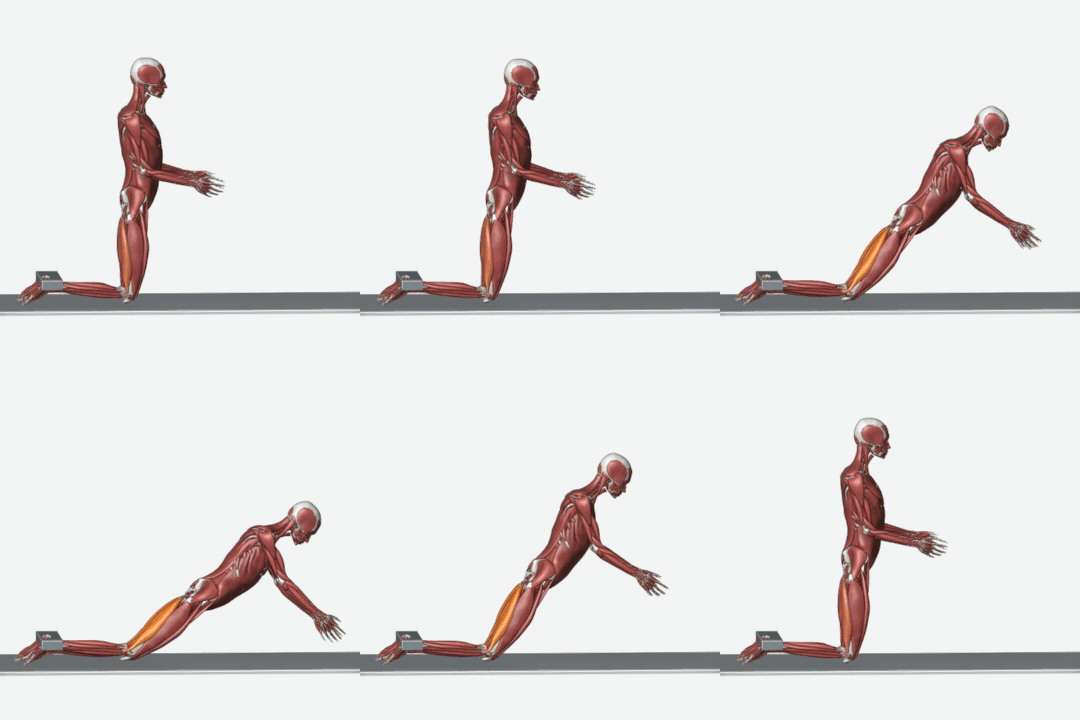
How to do it
Kneel on a mat with your ankles held by a partner or under a fixed bar. Keeping hips and trunk in one line, lower yourself forward as slowly as you can, catch yourself on your hands and push back up. Add repetitions week by week.
Default dose
2 × 5
This is the library's default dose. Each person's programme is set after assessment, around the grade of their finding and their own conditions and limits.
Muscles involved
- working while lengthening Hamstrings (biceps femoris), Hamstrings (semimembranosus and semitendinosus)
Muscle colours in the animation: orange working, blue stretching, amber holding still. These muscles were measured on the 3D model.
Where it sits in a programme: Integrate
The fourth phase is integration: using the new pattern in whole, everyday movements — standing, bending, squatting, walking — so the correction does not stay on the exercise mat.
Which postural findings it is prescribed for
It appears in the example programme on these pages:
Take care
- In the acute phase of a fresh injury, this exercise is taken off the programme.
- Cardiovascular disease — Only under supervision: Heavy eccentric load is done at near-maximal effort with a pull toward breath-holding; supervised only.
- High blood pressure — Only under supervision: A long isometric hold raises blood pressure while it is held, especially if the breath is held with it. It needs a shorter hold and continuous breathing out.
- Open growth plates (children and adolescents) — Taken off the programme: Heavy axial loading and maximal eccentrics on a growing skeleton do not happen without a paediatric orthopaedic opinion.
- Previous knee surgery (osteotomy, replacement, ligament) — Only under supervision: Loading and balancing on an operated knee only with the surgeon's or the treating physiotherapist's agreement.
- Inflammatory arthritis (rheumatoid and similar) — Only under supervision: High load on an inflamed joint; only outside a flare and supervised.
- If the movement causes pain or makes pain worse, stop and contact the clinic or your doctor.
Source
Trial or systematic review:
- van der Horst N, Smits DW, Petersen J, Goedhart EA, Backx FJ. The preventive effect of the Nordic hamstring exercise on hamstring injuries in amateur soccer players: a randomized controlled trial. Am J Sports Med. 2015;43(6):1316-23.
Trial: the Nordic hamstring exercise reduced hamstring injuries in footballers.
A related study summary on this site: That "50% reduction in hamstring injury" from the Nordic exercise — how well is it actually supported?