
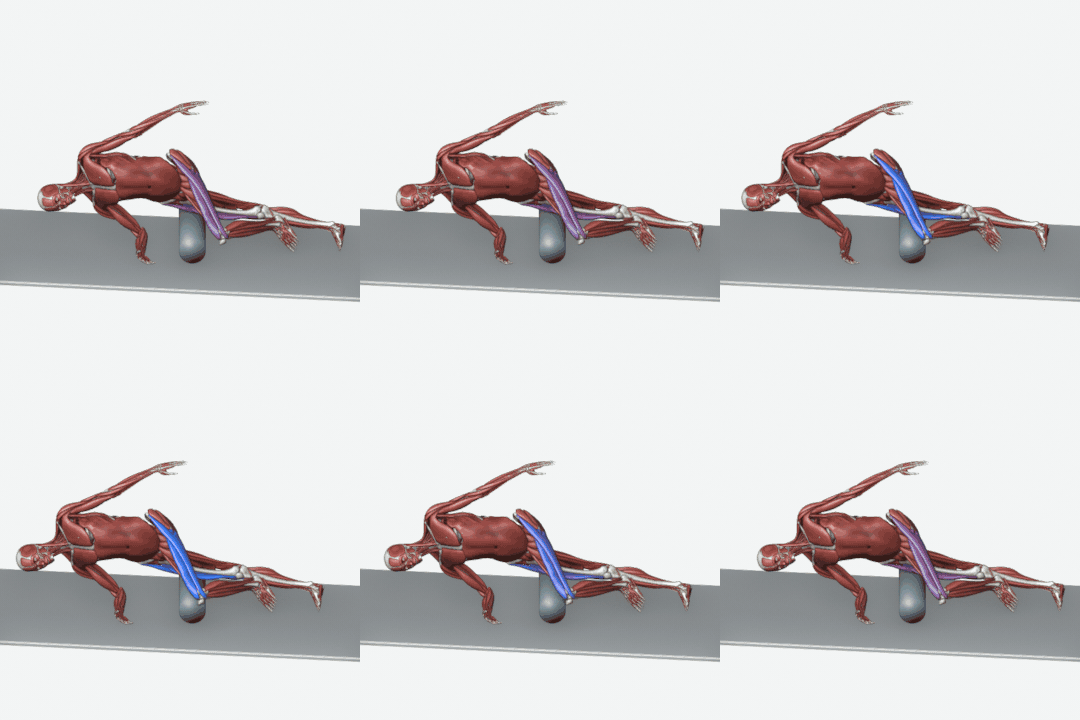
How to do it
On your side over the roller, just below the hip bone. Roll slowly.
Default dose
60s · each side
This is the library's default dose. Each person's programme is set after assessment, around the grade of their finding and their own conditions and limits.
Muscles involved
- release Tensor fasciae latae (TFL), Vastus lateralis (quadriceps)
Muscle colours in the animation: orange working, blue stretching, amber holding still. These muscles were measured on the 3D model.
Where it sits in a programme: Release and inhibit
The first phase of a corrective programme is release: easing the tension and sensitivity of overactive tissue — usually with gentle pressure from a ball or foam roller — so that the movements after it come more easily and more cleanly.
Which postural findings it is prescribed for
It appears in the example programme on these pages:
Take care
- If the movement causes pain or makes pain worse, stop and contact the clinic or your doctor.
Source
Textbook:
- Clark MA, Lucett SC. NASM Essentials of Corrective Exercise Training. Lippincott Williams & Wilkins; 2011.
The four-phase corrective continuum — inhibit, lengthen, activate, integrate — this library is ordered by. - Cheatham SW, Kolber MJ, Cain M, Lee M. The effects of self-myofascial release using a foam roll or roller massager on joint range of motion, muscle recovery, and performance: a systematic review. Int J Sports Phys Ther. 2015;10(6):827-38.
Systematic review: foam rolling may give a short-term gain in range of motion; the studies are small and their methods vary.