
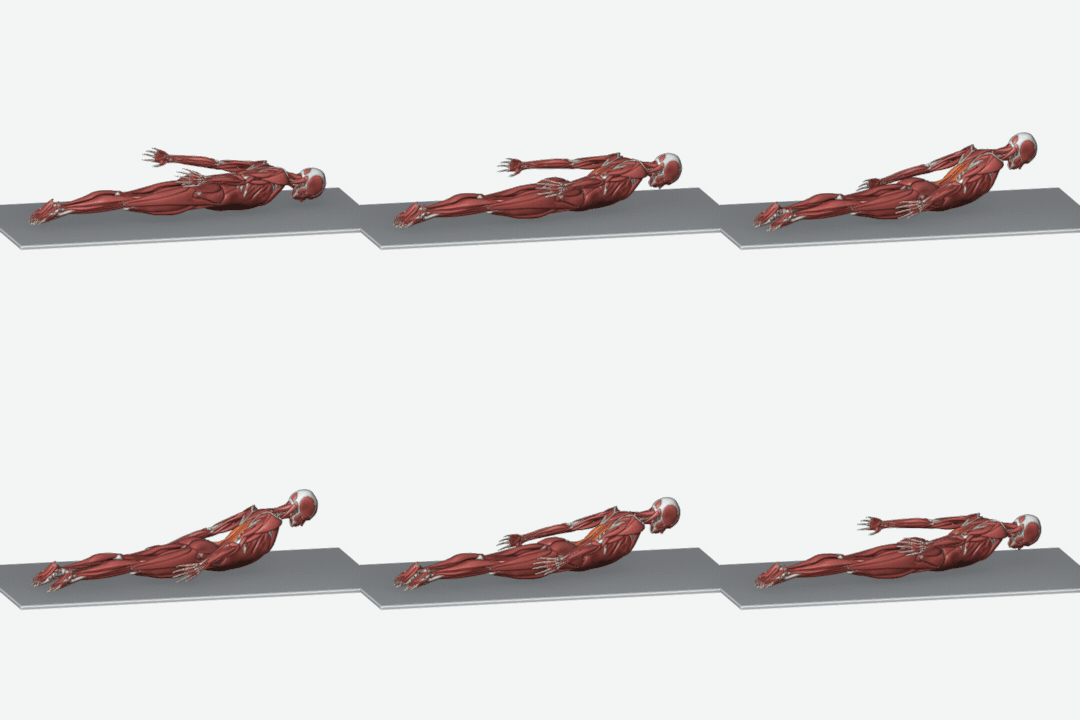
How to do it
Face down, arms by your sides, palms up. Lift the chest a few centimetres, chin slightly tucked and eyes on the floor; hold three seconds. Do not tip the head back.
Default dose
3 × 10 · 3s
This is the library's default dose. Each person's programme is set after assessment, around the grade of their finding and their own conditions and limits.
Muscles involved
- working Erector spinae, thoracic, Erector spinae, lumbar, Multifidus and deep spinal muscles
Muscle colours in the animation: orange working, blue stretching, amber holding still. These muscles were measured on the 3D model.
Where it sits in a programme: Activate the weak
The third phase is activation: strengthening a muscle that has become weak or underused, with controlled movement and light load, so it can carry its share of holding the body up.
Which postural findings it is prescribed for
It appears in the example programme on these pages:
Take care
- Pregnancy — Taken off the programme: Lying face down on the abdomen is not appropriate as pregnancy progresses; the same muscles are worked on hands and knees or sitting.
- If the movement causes pain or makes pain worse, stop and contact the clinic or your doctor.
Source
Trial or systematic review:
- Bansal S, Katzman WB, Giangregorio LM. Exercise for improving age-related hyperkyphotic posture: a systematic review. Arch Phys Med Rehabil. 2014;95(1):129-40.
Systematic review: spinal extensor strengthening reduces age-related hyperkyphosis. - Katzman WB, Vittinghoff E, Lin F, et al. Targeted spine strengthening exercise and posture training program to reduce hyperkyphosis in older adults: results from the study of hyperkyphosis, exercise, and function (SHEAF) randomized controlled trial. Osteoporos Int. 2017;28(10):2831-41.
Trial: targeted spine strengthening with posture training reduced the kyphosis angle. - Giangregorio LM, Papaioannou A, Macintyre NJ, et al. Too Fit To Fracture: exercise recommendations for individuals with osteoporosis or osteoporotic vertebral fracture. Osteoporos Int. 2014;25(3):821-35.
Consensus: for osteoporosis, back extensor strengthening and balance training; avoid repeated loaded flexion.