
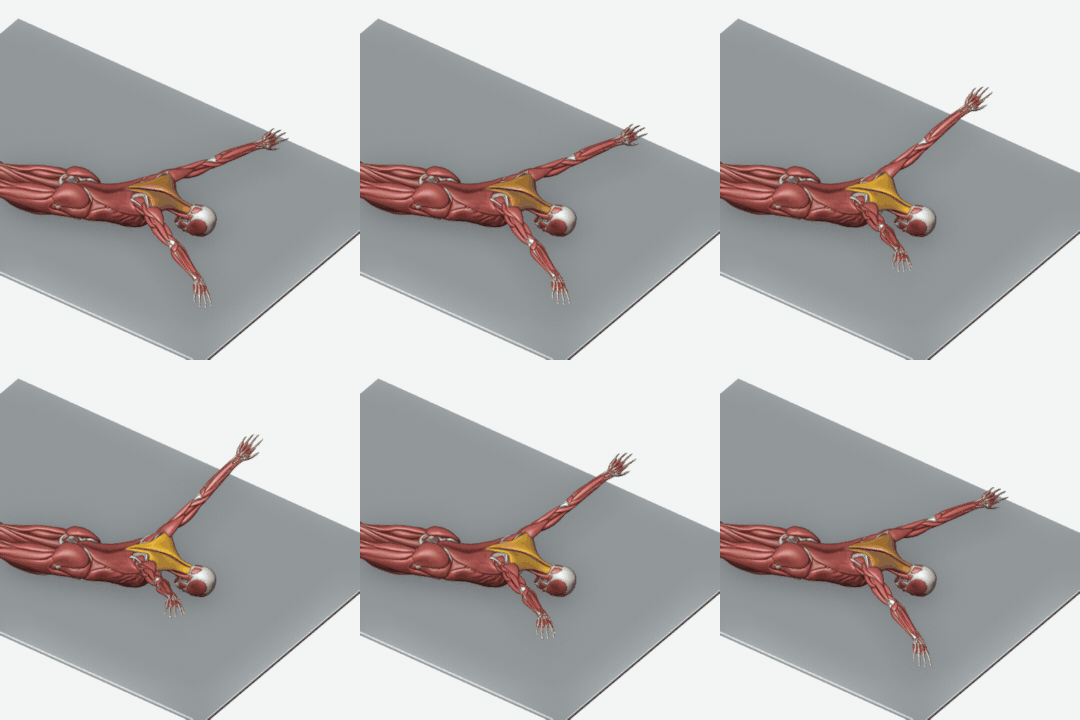
How to do it
Face down, thumbs up, lift the arms into a Y. Keep the shoulders away from the ears.
Default dose
3 × 12 · 3s
This is the library's default dose. Each person's programme is set after assessment, around the grade of their finding and their own conditions and limits.
Muscles involved
- holding still Trapezius
Muscle colours in the animation: orange working, blue stretching, amber holding still. These muscles were measured on the 3D model.
Where it sits in a programme: Activate the weak
The third phase is activation: strengthening a muscle that has become weak or underused, with controlled movement and light load, so it can carry its share of holding the body up.
Which postural findings it is prescribed for
It appears in the example programme on these pages:
Take care
- Pregnancy — Taken off the programme: Lying face down on the abdomen is not appropriate as pregnancy progresses; the same muscles are worked on hands and knees or sitting.
- If the movement causes pain or makes pain worse, stop and contact the clinic or your doctor.
Source
Measurement study:
- Ekstrom RA, Donatelli RA, Soderberg GL. Surface electromyographic analysis of exercises for the trapezius and serratus anterior muscles. J Orthop Sports Phys Ther. 2003;33(5):247-58.
EMG: raising the arm overhead face down, in line with the lower trapezius fibres, activated lower trapezius most. - Cools AM, Dewitte V, Lanszweert F, et al. Rehabilitation of scapular muscle balance: which exercises to prescribe? Am J Sports Med. 2007;35(10):1744-51.
EMG: the exercises that work middle and lower trapezius with the least upper trapezius, side-lying external rotation among them.